Eligibility
Which taxonomy activity this facility maps to, and under which contribution objective.
GreenScreen takes a described facility, matches it against the Kenya Green Finance Taxonomy, sets out the criteria and evidence the matched activity requires, and records the rationale for the outcome — so the position can be explained at review.
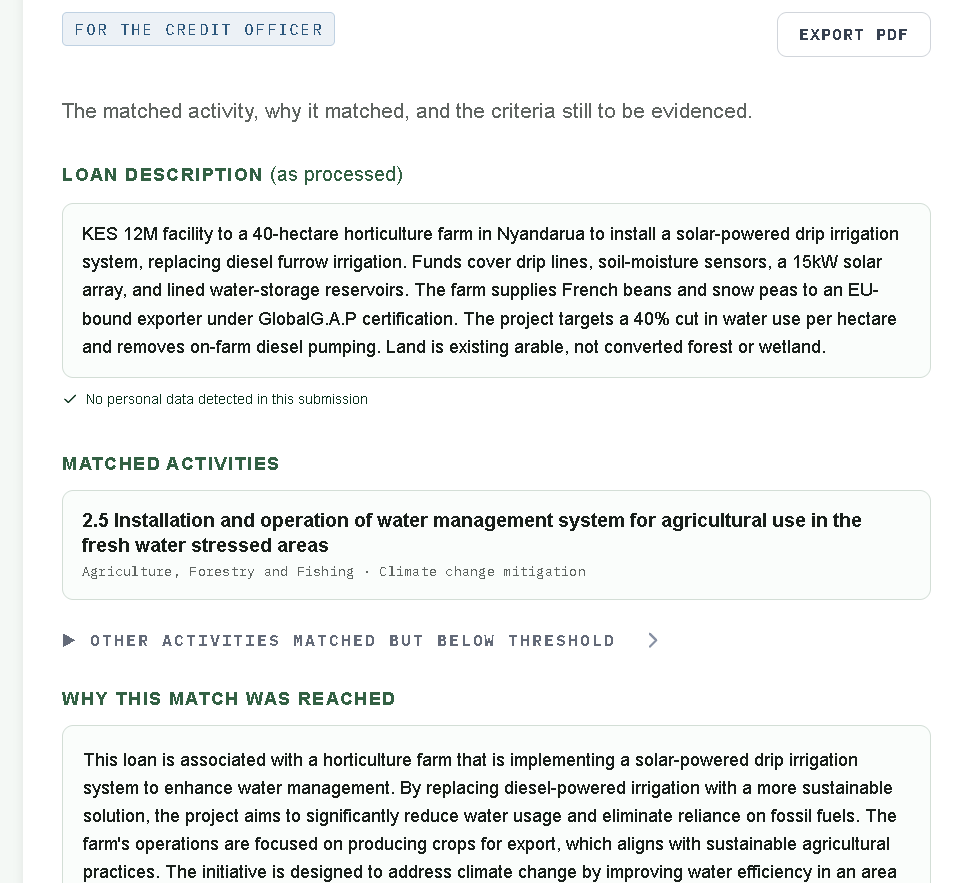
“Is it green?” is really four questions, and a single yes or no buries the three that decide whether a position survives review. GreenScreen answers each one separately.
Which taxonomy activity this facility maps to, and under which contribution objective.
How the activity measures against the technical screening criteria for that match, criterion by criterion.
The specific documents and confirmations still needed, named and ready to request.
How far the available information supports the position — so a thin description is visible as a thin description.
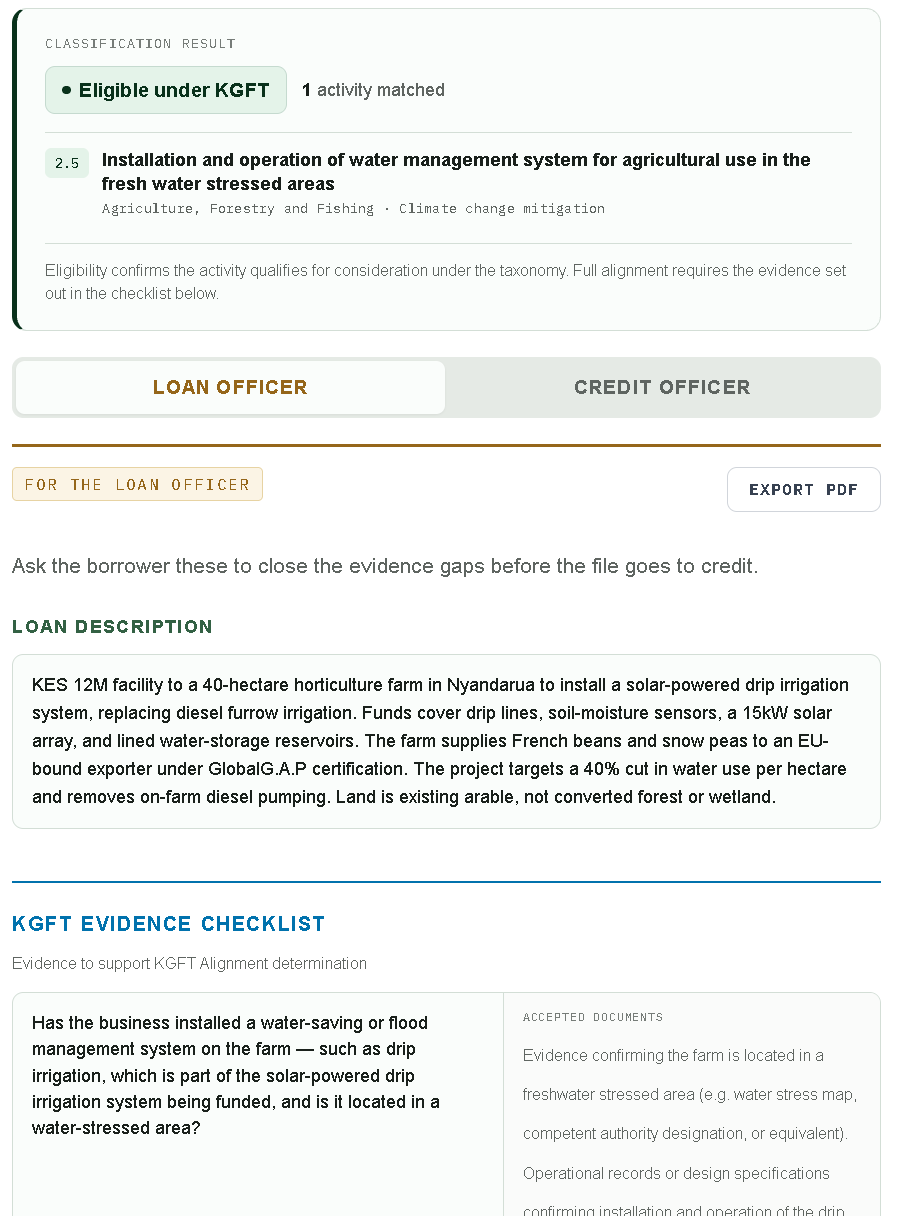
The verdict states the eligibility position and how many activities matched. Beneath it, the checklist turns the matched activity's criteria into questions an officer can put to the borrower, each with the documents that would close it.
We know the taxonomy's own gaps. KGFT v1.0 specifies technical screening criteria for 66 of its 99 activities. GreenScreen knows which 66, and for the remaining 33 it tells you exactly what the framework leaves open rather than borrowing criteria from a neighbouring activity. That is the difference between a defensible file and a confident guess.
A described facility is matched against the structured taxonomy registry across all 11 priority sectors, with the ranked candidates retained rather than discarded.
The criteria for the matched activity are expressed as questions a loan officer can actually ask, instead of regulatory text to interpret on the spot.
Excluded activities are blocked early; financing that replaces a higher-emitting process is treated as a transition case rather than an automatic exclusion.
Physical and transition risk context is attached by county across all 47 counties, on sourced hazard data, so the geography of a facility is part of the record from the start.
Inputs, matched activity, criteria status, evidence gaps and the officer's conclusion are kept together as a single assessment record.
A set of facilities can be screened together to produce a portfolio view of eligibility positions and outstanding evidence.
Released by the Central Bank of Kenya in April 2025 alongside the Climate Risk Disclosure Framework. It identifies 11 priority economic sectors and sets screening criteria at activity level.
Adoption is voluntary today, and CBK has said the timetable for mandatory application is under review. We track that position closely, and we state it plainly rather than inventing a deadline.
Both reasons are commercial, and neither waits for a mandate.
A demonstration runs on a small set of real or representative facilities, so you can see how the classification, criteria mapping and evidence gaps behave on data you recognise.